Nov.02, 2026
Stainless Steel Rope Mesh, also known as Stainless Steel Cable Mesh, is a flexible metal mesh made from interconnected stainless steel wire ropes. Its open structure provides physical separation while maintaining visibility and airflow, making it suitable for selected security barrier and anti-drone protection applications.
For projects involving oil and gas facilities, airports, power stations, and other critical infrastructure, choosing the right mesh requires more than checking the rope diameter and opening size. Material grade, rope construction, ferrule connections, panel dimensions, supporting structures, and the required level of protection all need to be considered.
Hebei Jizhuang Technology Co., Ltd. (Jizhuang Tech) manufactures customized stainless steel rope mesh panels and compatible accessories. This article introduces the available specifications, material options, connection components, quality documents, and key considerations for project buyers.
Stainless steel rope mesh is formed by connecting individual wire ropes through ferrules or other mesh construction methods. The finished panels generally have a flexible diamond-shaped structure, with mesh openings and dimensions customized according to project requirements.
In anti-drone projects, rope mesh can be used as a passive physical barrier around selected areas or equipment. Depending on the installation design, panels may be fixed to supporting frames, perimeter structures, or protective enclosures.
Typical applications include:
Oil storage tanks and oil and gas facilities
Airports and aviation infrastructure
Military and defense facilities
Power plants and electrical substations
Data centers and communication facilities
Ports and other critical infrastructure
Unlike electronic counter-drone equipment, stainless steel rope mesh does not detect, track, or interfere with drone signals. Its role is physical separation. The suitable mesh configuration depends on the protected area, installation conditions, and the specific threat being addressed.
The main factors affecting rope mesh selection are stainless steel grade, wire rope construction, rope diameter, mesh opening, connection method, and panel dimensions.
Product Name: Stainless Steel Rope Mesh / Stainless Steel Cable Mesh
Material Grade: AISI 304 / 304L / 316 / 316L
Wire Rope Construction: 7×7 / 7×19
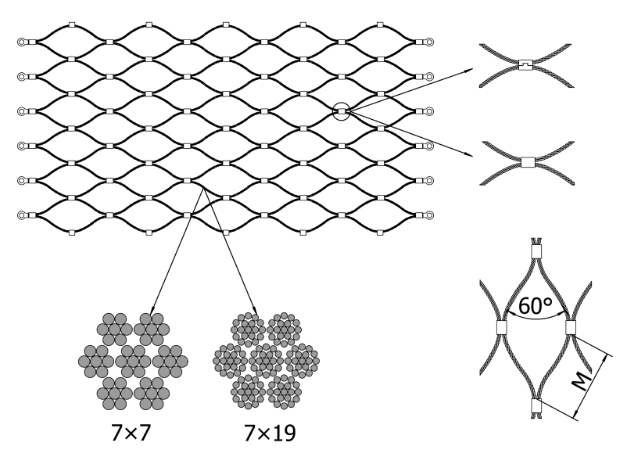
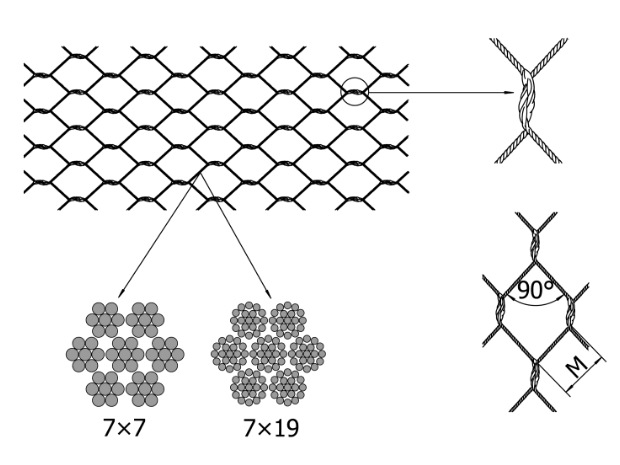
Wire Rope Diameter: 1.2 mm / 1.5 mm / 2.0 mm / 3.0 mm / 4.0 mm / Custom
Mesh Opening: 20×20 mm to 300×300 mm / Custom
Mesh Type: Ferrule Type / Knotted / Interwoven
Mesh Shape: Diamond / Rhombus
Ferrule Material: Stainless Steel / Aluminum Alloy
Panel Dimensions: Custom Width × Height
Edge Treatment: Standard Edge / Reinforced Edge / Boundary Rope
Surface Finish: Natural Stainless Steel
Packaging: Customized Export Packaging
These are possible configuration options. Actual production availability and compatible combinations should be confirmed against the manufacturer's production capabilities and approved project drawings.
The operating environment is an important factor when selecting stainless steel.
AISI 304: Commonly used in general indoor and outdoor environments with moderate corrosion exposure.
AISI 304L: A low-carbon version of 304, often considered where fabrication or welding requirements make a low-carbon grade preferable.
AISI 316: Contains molybdenum, which improves resistance to chloride-related corrosion. It is often considered for coastal and marine environments.
AISI 316L: A low-carbon version of 316, suitable for applications with specific fabrication or welding requirements.
For facilities exposed to salt spray, moisture, or industrial chemicals, buyers should consider the actual site conditions rather than selecting a material based on price alone.
Wire rope construction affects flexibility and handling characteristics.
7×7 wire rope offers a balance between flexibility and structural stability. It may be considered where a relatively firm mesh structure is required.
7×19 wire rope is generally more flexible than a comparable 7×7 rope. It may be suitable for applications where greater flexibility is needed.
The final selection should also take into account rope diameter, mesh opening, panel size, connection design, and supporting structure.
The mesh panel is only one part of the installation. Its edges, connection points, and fixing components must be compatible with the selected mesh and supporting structure.
Jizhuang Tech can coordinate stainless steel rope mesh panels with compatible accessories according to customer specifications.
Ferrules: Stainless steel or aluminum components used to connect intersecting wire ropes and form the mesh openings.
Boundary Cables: Stainless steel cables installed along panel edges for perimeter reinforcement or connection arrangements.
Wire Rope Clips and Cable Clamps: Used for specified cable-end fixing and wire rope connections.
Turnbuckles and Tensioners: Allow cable tension to be adjusted during installation.
Shackles and Connecting Rings: Provide connection points between compatible cables, mesh panels, and structural components.
Thimbles and Cable End Terminals: Help protect wire rope loops and provide suitable cable-end connections.
Eye Bolts and Fasteners: Used for designated attachment and fixing arrangements.
Mounting Brackets and Fixing Plates: Connect mesh panels or support cables to frames and other structural members.
When ordering accessories, buyers should confirm the rope diameter, material compatibility, connection method, and required load capacity. The rating of an individual fitting should not be treated as the performance rating of the complete mesh assembly.
A drone-related incident may create hazards beyond the aircraft itself. During an impact or explosive event, fragments from the drone, damaged equipment, or surrounding structures may become secondary hazards.
Depending on the incident, flying debris may damage:
Oil tank valves, fittings, and pipeline connections
Electrical cables and control cabinets
Sensors, instruments, and communication equipment
External equipment and supporting structures
Other exposed components near the protected area
At an oil and gas facility, damage to a relatively small component, such as a valve or pipeline connection, may interrupt operations and create additional safety risks.
Stainless steel rope mesh can serve as a physical barrier, but a standard mesh panel should not automatically be considered blast-resistant or fragment-proof.
Its ability to withstand impact depends on the rope diameter, mesh opening, ferrule connections, edge reinforcement, supporting structure, installation method, and actual impact conditions.
Where fragment hazards are identified in a project risk assessment, a multi-layer protection approach may be required.
A project-specific arrangement may include:
Outer Physical Barrier: Stainless steel rope mesh or another suitable barrier, selected according to the assessed threat.
Fragment Protection Layer: A separately engineered protective layer designed to reduce the risk of fragments reaching sensitive equipment.
Structural Support: Frames, anchors, fixing plates, and connections designed for the expected loads.
Equipment-Level Protection: Additional shielding, separation, or relocation of vulnerable components where practical.
The materials, layer spacing, thickness, and structural arrangement must be determined by qualified engineers. The assessment should consider fragment size, velocity, direction, impact energy, explosive effects, and the vulnerability of the protected equipment.
Important: Stainless steel rope mesh alone should not be claimed to stop all fragments or prevent blast damage. Multi-layer protection requires project-specific engineering and, where necessary, independent testing of the complete assembly.
Different infrastructure projects have different installation conditions. Mesh panels may require specific dimensions, edge treatments, connection details, and accessory arrangements to fit the project drawings.
Established in 2000, Hebei Jizhuang Technology Co., Ltd. integrates product design, R&D, manufacturing, sales, and installation services. The company operates a manufacturing facility covering approximately 25,000 m², with more than 100 wire mesh production machines.
For stainless steel rope mesh orders, customization can cover:
Material: AISI 304, 304L, 316, or 316L stainless steel
Rope Construction: 7×7 or 7×19
Rope Diameter: According to the required mesh configuration
Mesh Opening: Customized opening sizes and panel layouts
Ferrules: Stainless steel or aluminum options
Panel Dimensions: Width, height, and quantity based on project drawings
Edge Treatment: Standard edges, reinforced edges, or boundary cables
Accessories: Compatible clips, tensioners, shackles, brackets, and fixing components
Packaging: Export packaging and customer labels
Buyers can provide CAD drawings, dimensions, or reference photos for a manufacturing review. Before production, the mesh configuration, panel dimensions, edge details, and accessory requirements should be confirmed.
Our manufacturing scope covers stainless steel rope mesh panels and compatible components. Complete anti-drone system integration, blast engineering, and fragment-protection design should be handled by qualified project specialists unless separately agreed.
For engineering and infrastructure projects, buyers need more than a product description. They also need documents that help verify the material, product specifications, inspection results, and delivery details.
The required documents should be agreed upon before production. Depending on the order and inspection arrangements, buyers may request:
Stainless Steel Material Certificate
Helps verify the stated stainless steel grade and relevant chemical composition. Buyers should check that the certificate information corresponds to the supplied material or production batch.
Wire Rope Inspection or Test Report
May record wire rope construction, diameter, and agreed mechanical test results. Where breaking force is a project requirement, the test method and measured result should be identified.
Standard or Compliance Declaration
Where a specific standard is required by the purchase order, buyers should request confirmation of the applicable standard, product scope, and supporting evidence.
Mesh Dimension Inspection Report
Records panel width, height, mesh opening, and other agreed dimensions.
Ferrule Connection Inspection Record
Records inspection of ferrule connections and crimping quality according to the agreed inspection criteria.
Finished Product Inspection Report
Summarizes the final inspection of the mesh panel, including appearance, dimensions, edge condition, and accessory configuration.
Depending on the order and destination requirements, buyers may also request:
Commercial Invoice
Packing List
Product Labels
Certificate of Origin, where required
Agreed material certificates and inspection records
Before approving an order, check that:
The material grade matches the purchase order.
The wire rope diameter and construction match the approved specifications.
The mesh opening and panel dimensions meet the approved drawings.
Inspection results can be traced to the supplied product or production batch.
The accessories and quantities match the agreed packing details.
A document is useful only when its scope, issuing party, product identification, and test results are clear. Buyers should also distinguish between a manufacturer's inspection report, a material supplier's certificate, and an independent third-party test report.
Documents should only be listed as available when they can actually be provided for the relevant order. Any special certificate or third-party inspection requirement should be agreed before production.
To prepare an accurate quotation and avoid unnecessary specification revisions, buyers should provide as much of the following information as possible:
Application and project location: For example, an oil storage facility, airport, or industrial site.
Material grade: AISI 304, 304L, 316, or 316L.
Wire rope construction and diameter: 7×7, 7×19, or another specified configuration.
Mesh opening: Required opening size and measurement method.
Panel dimensions: Width, height, and estimated quantity.
Ferrule and edge requirements: Material, connection type, and edge reinforcement.
Accessories: Required cables, clips, tensioners, shackles, or fixing components.
Drawings or reference photos: CAD drawings are helpful for confirming dimensions and connections.
Inspection requirements: Material certificates, test reports, inspection records, or third-party verification.
Delivery requirements: Destination, packaging, and expected delivery schedule.
For projects involving potential explosions or fragment hazards, the protection objective and engineering validation criteria should also be provided. Ordinary mesh specifications alone cannot determine the performance of a complete protective structure.
Jizhuang Tech manufactures customized stainless steel rope mesh panels and compatible connection components for industrial and infrastructure projects.
Whether you need a specific rope diameter, mesh opening, panel dimension, ferrule configuration, or accessory arrangement, our team can review your drawings and manufacturing requirements before quotation.
Send us your technical drawings, required specifications, inspection requirements, and estimated quantity to discuss your project.
Company: Hebei Jizhuang Technology Co., Ltd. (Jizhuang Tech)
Website: https://www.jzwiremesh.com
Email: admin@jzwiremesh.com
Technical References
The following standards provide technical references for stainless steel wire materials, wire rope manufacturing, mechanical testing, and applicable cable-end connections. Each standard covers a specific area and should be applied according to the product and project requirements.
ISO 3444:2023 – Stainless-Steel Wire Ropes
Covers the manufacture, classification, testing, packaging, marking, and certification of stainless steel wire ropes. Relevant when specifying the wire ropes used in mesh production.
ASTM A492-95(2019) – Standard Specification for Stainless Steel Rope Wire
Covers commonly used round stainless steel wires intended for stranding into wire ropes, including chemical composition and tensile strength requirements.
ISO 3108:2017 – Steel Wire Ropes: Determination of Measured Breaking Force
Provides a test method for determining the measured breaking force of steel wire ropes. It is relevant when wire rope breaking force needs to be verified.
ISO 8793 – Steel Wire Ropes: Ferrule-Secured Eye Terminations
Provides requirements for applicable ferrule-secured wire rope eye terminations. It is a reference for specific cable-end connections, not a general acceptance standard for every ferrule intersection in a mesh panel. The 1986 edition is undergoing revision; buyers should confirm the applicable edition when specifying this reference.
View ISO 8793 and its revision status
Technical Note: These standards cover specific materials, wire ropes, test methods, or connection types. They do not automatically certify a finished stainless steel rope mesh panel or a complete anti-drone protection system. Buyers should confirm the applicable standards, inspection criteria, and required test documents before production.
Related News
Nov.05, 2026
Types of Reinforcement Mesh: Classification, Structures and Applications
Nov.04, 2026
Oct.20, 2026
SL82 Reinforcing Mesh: Quality Inspection & Export Shipment
Oct.09, 2026