Blog & News
Nov.05, 2026
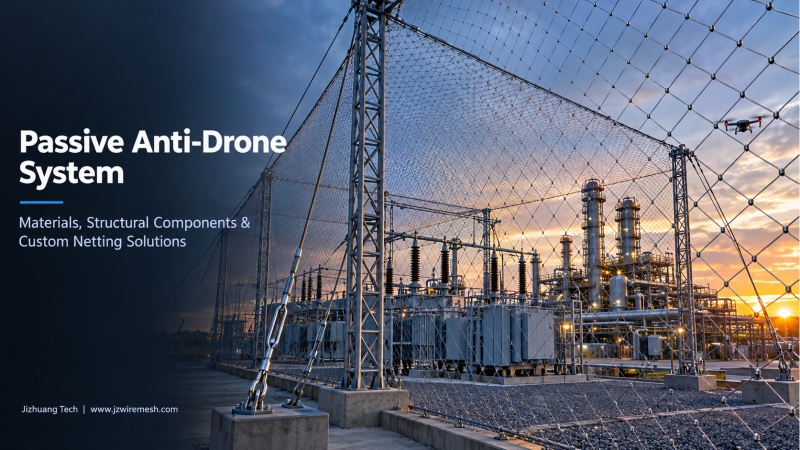
As unmanned aerial vehicles (UAVs), commonly known as drones, become more accessible, protecting critical infrastructure and industrial facilities from unauthorized drone access has become an increasingly important security consideration. Physical protection systems are gaining attention as part of a broader infrastructure security strategy, particularly where sensitive equipment, restricted areas and operational assets require an additional protective barrier.
A Passive Anti-Drone System uses physical structures, specialized netting materials and supporting components to create a protective enclosure around or above a facility. Unlike active counter-drone technologies, which rely on detection, tracking or electronic countermeasures, passive systems focus on establishing a physical barrier.
Depending on project requirements, these systems may incorporate stainless steel rope mesh, galvanized wire mesh, textile rope nets, UHMWPE protective materials, steel support structures and specialized connection accessories.
For industrial buyers, EPC contractors and security system integrators, selecting a suitable solution requires more than choosing a mesh product. Material specifications, mesh configuration, structural stability, installation conditions and long-term maintenance all need to be considered together.
A passive anti-drone system is a physical protection arrangement designed to restrict unauthorized drone access to designated areas or create a protective separation between drones and sensitive assets.
Its main components can include:
Unlike active counter-drone systems, passive protection does not depend on radar detection, radio-frequency interference or signal jamming to operate. Instead, it relies on the physical properties and structural configuration of the installed barrier.
The effectiveness of a passive system depends on the intended protection objective, mesh opening, material properties, installation geometry and structural design. A mesh barrier should not automatically be considered capable of stopping every type of drone or resisting every impact condition.
The basic principle of passive protection is to establish a physical boundary using appropriately selected mesh materials and supporting structures.
Depending on the project, a barrier can be installed vertically, horizontally or as a three-dimensional enclosure.
The mesh forms the primary physical barrier, while its supporting framework maintains the required geometry and transfers design loads to the supporting structure and foundations.
Several technical factors influence the design:
For cable-supported systems, the interaction between the mesh, supporting cables, tensioning components and foundations must be evaluated as part of the overall structural design.
Some passive protection concepts use more than one protective contour.
An outer contour may consist of a spatial net shelter supported by independent masts, cables and foundations. An inner contour may use UHMWPE protective mats or other engineered screening materials installed on a separate frame closer to the protected equipment.
These two contours can function independently or as parts of an integrated protection arrangement.
The design relationship between the outer and inner layers depends on facility dimensions, required clearances, equipment configuration and project-specific engineering calculations.
A multi-layer arrangement should not be interpreted as a guaranteed protection level. Its performance must be evaluated through appropriate engineering analysis and testing.
Structural performance is an essential consideration when designing a passive anti-drone enclosure.
A complete system may involve several connected elements:
When a load is applied to a mesh structure, the resulting forces are transferred through its connections and supporting members. The behavior depends on material properties, mesh geometry, pretension, support spacing and boundary conditions.
For this reason, mesh tensile strength alone cannot establish the performance of an entire anti-drone system.
Project-specific calculations and, where required, physical testing should be used to evaluate deformation, connection integrity, support stability and other relevant performance criteria.
Stainless steel rope mesh is an important material option for permanent physical protection structures.
It is manufactured from interconnected stainless steel wire ropes, with mesh configurations formed through ferrules or other specified connection methods.
Its main characteristics include:
Two common configurations are ferrule-type stainless steel rope mesh and knotted stainless steel rope mesh.
The selection depends on the required mesh geometry, connection details, appearance and engineering specifications.
For procurement, buyers should confirm the stainless steel grade, rope construction, nominal rope diameter, mesh opening, panel dimensions, edge finishing and connection details.
At Jizhuang Tech, stainless steel rope mesh manufacturing and customization form part of our wire mesh product portfolio. We can discuss mesh specifications and panel configurations according to project requirements.
An outer net shelter is a spatial protective enclosure constructed using mesh panels, supporting structures and connecting components.
Rather than functioning as an isolated mesh sheet, it combines multiple structural elements to establish a defined protective boundary.
Typical components include:
The mesh configuration may be adapted to the required enclosure geometry, while the supporting arrangement must account for structural loads, site conditions and maintenance access.
Modular configurations can also be considered where the project requires different enclosure dimensions or phased installation.
For manufacturers and suppliers, accurate mesh panel dimensions, edge construction and connection compatibility are important for coordinating mesh production with the overall structural design.
UHMWPE stands for Ultra-High Molecular Weight Polyethylene. It is an engineering thermoplastic known for its abrasion resistance, impact resistance, low friction and chemical resistance.
In certain passive protection concepts, UHMWPE fiber-based materials can be manufactured into layered protective mats or panels and mounted on independent frames.
Important considerations include:
It is important to distinguish conventional UHMWPE plastic sheets from engineered UHMWPE fiber-based protective materials. They have different material structures and performance characteristics.
The performance of a finished protective mat depends on its material composition, construction, connections and test conditions. Buyers should request relevant technical data and test documentation rather than relying on the material name alone.
UHMWPE mats are a specialized component option and should not be considered a standard product supplied in every passive anti-drone system.
Supporting structures provide the framework required to install and maintain the protective mesh.
Depending on the system design, these structures may include:
Their main purpose is to maintain the designed mesh geometry and transfer structural loads to the supporting foundations.
The selection of steel sections, cable specifications, support spacing and anchoring methods should be based on project-specific engineering requirements.
For industrial projects, supporting structures also need to account for corrosion exposure, wind loads, maintenance access and compatibility with existing infrastructure.
Connection fittings are essential components of rope mesh and cable-supported protection systems.
They connect mesh panels to supporting cables or frames and help maintain the required installation configuration.
Common accessories include:
Material compatibility, corrosion resistance, dimensional accuracy and connection quality should be considered when selecting these accessories.
For stainless steel rope mesh panels, ferrule quality and connection consistency are particularly important because they influence the integrity of the mesh assembly.
Accessories should be selected according to the rope diameter, connection design, expected loading conditions and installation requirements.
Textile rope nets provide another material option for passive physical barriers.
Compared with stainless steel rope mesh, textile nets generally offer lower weight and greater flexibility, making them suitable for configurations where temporary installation, portability or rapid deployment is important.
Their specifications may include:
Material selection should consider the expected exposure conditions, required service life, mechanical performance and maintenance arrangements.
Textile rope nets and stainless steel rope mesh should not be treated as interchangeable products. Each has different material properties and project suitability.
An inner protective contour is a secondary protective arrangement positioned closer to the equipment or building envelope.
It may consist of UHMWPE protective mats, additional mesh layers or other engineered screening materials installed on an independent support frame.
When combined with an outer net shelter, the two contours create a layered physical protection concept.
The design should consider:
The inner and outer contours should be designed as coordinated components rather than simply adding multiple layers of material without evaluating their structural relationship.
Stainless steel rope mesh is commonly considered for permanent installations where corrosion resistance, durability and flexible panel configurations are important.
Relevant material grades may include AISI 304 and AISI 316, subject to the environmental conditions and project specifications.
AISI 316 may be considered for more demanding chloride-containing environments, but the appropriate grade should be determined according to the actual exposure conditions.
Procurement specifications should identify the stainless steel grade, rope diameter, rope construction, mesh opening, connection type and panel dimensions.
Galvanized steel wire mesh provides another option for physical barriers and protective enclosures.
The zinc coating helps protect the underlying steel from corrosion, with performance depending on coating quality, thickness, environmental exposure and maintenance.
Different configurations can be manufactured according to project requirements, including chain link mesh and other galvanized wire mesh products.
Buyers should confirm wire diameter, mesh opening, coating requirements, edge treatment and panel or roll dimensions.
UHMWPE fiber is a high-performance synthetic fiber with a high strength-to-weight ratio.
It is used in specialized protective textiles, ropes and composite structures.
For passive protection projects, buyers should distinguish between UHMWPE fiber products and conventional solid UHMWPE plastic components.
Material data, layer construction and relevant impact or penetration testing are necessary when evaluating protective performance.
Synthetic rope materials can be used in lightweight net structures and temporary protection configurations.
Their properties vary according to fiber type, rope construction and manufacturing process.
Important evaluation factors include tensile properties, UV resistance, abrasion resistance, moisture exposure and connection performance.
The selected rope material should be compatible with the intended installation environment and service requirements.
No single material is suitable for every passive protection project.
A practical material selection process should consider:
Material specifications should be finalized together with the engineering team responsible for the complete protection system.
Oil and gas infrastructure contains equipment and operational areas that may require additional physical security measures.
Passive protection concepts can incorporate overhead net structures, perimeter mesh barriers and localized equipment screening.
Material selection should consider corrosion exposure, environmental conditions, equipment clearance and access for inspection and maintenance.
Airport infrastructure requires carefully coordinated security arrangements that do not interfere with aircraft operations, maintenance activities or emergency access.
Physical mesh systems may be considered as part of a wider protection concept for selected structures and restricted areas.
Mesh configuration, structural clearances and installation constraints must be evaluated by qualified project engineers.
Electrical infrastructure contains transformers, switchgear and other sensitive equipment.
Protective mesh enclosures and secondary screening structures may be considered where additional physical separation is required.
Design considerations include electrical clearances, ventilation, heat dissipation, maintenance access and compatibility with existing equipment foundations.
Data centers depend on continuous operation and the protection of critical equipment.
Passive physical barriers may form part of a broader site security strategy.
The design should consider building geometry, access control, cooling requirements, service routes and the integration of existing security systems.
Military and government facilities may have project-specific security requirements and controlled access conditions.
Mesh barriers, rope net structures and supporting frameworks can be evaluated as part of a wider physical protection plan.
Material specifications and performance requirements should follow the applicable project documentation and relevant procurement standards.
Industrial compounds may require customized perimeter or overhead protective structures.
The choice of mesh material and supporting configuration depends on facility layout, environmental conditions and the intended protection objectives.
Custom mesh panels and coordinated connection accessories can help match the protective structure to the project geometry.
Passive and active counter-drone systems operate through different protection mechanisms.
Passive systems establish physical barriers using mesh structures, protective panels and supporting frameworks.
Active systems may use radar, optical sensors, radio-frequency detection, tracking technologies or other electronic countermeasures.
The two approaches address different parts of the security process and should not be regarded as direct substitutes.
Passive systems offer several potential advantages:
However, passive systems also have limitations.
They do not independently detect, identify or track drones. Their performance depends on physical design, structural capacity, installation quality and the characteristics of the potential impact.
They may also require substantial supporting structures and site-specific engineering.
A passive barrier should therefore be selected according to a clearly defined protection objective rather than assumed to provide universal drone protection.
Passive protection can complement active security technologies.
For example, a site may use electronic detection systems to monitor potential drone activity while physical mesh structures provide an additional protective boundary around selected assets.
The integration of these measures should be coordinated by the security system designer, taking into account operational procedures, regulatory requirements and site-specific risks.
Mesh opening and rope diameter are two important specifications when manufacturing stainless steel rope mesh.
The appropriate combination depends on the required mesh geometry, structural design, material properties and project conditions.
Buyers should provide the following information when requesting a quotation:
Customized specifications should be confirmed through technical drawings or approved samples before production.
Mesh panels can be manufactured in different shapes and dimensions to match the overall enclosure design.
Relevant requirements include:
Accurate dimensional information helps coordinate manufacturing, transportation and on-site installation.
Connection accessories should match the selected mesh and supporting structure.
Depending on the project, customized supply may include ferrules, cable connectors, fixing components, tensioning accessories and related installation hardware.
Compatibility between the rope diameter, fitting dimensions and installation method should be confirmed before production.
A passive anti-drone system may require additional steel frames, support posts, cables and anchoring components.
Their dimensions and configurations should be developed according to the project drawings and structural calculations.
As a wire mesh manufacturer, Jizhuang Tech can support customized mesh products and coordinate product specifications with project requirements. Structural calculations, foundation design and installation engineering should be confirmed by the responsible engineering professionals.
For distributors, security contractors and engineering procurement companies, consistent manufacturing quality and reliable product specifications are important.
Jizhuang Tech supports OEM manufacturing and customized wire mesh production according to customer drawings, technical specifications and agreed quality requirements.
Our manufacturing scope includes stainless steel rope mesh, welded wire mesh, chain link fence, hexagonal wire mesh and perforated metal mesh.
This product range allows buyers to discuss different mesh material options and coordinate product sourcing according to their project requirements.
Material quality is the starting point of reliable mesh manufacturing.
Depending on the product, inspection may include:
For stainless steel products, confirming the material grade is particularly important when corrosion resistance is a project requirement.
Stainless steel rope mesh manufacturing involves rope preparation, mesh forming, connection processing and panel finishing.
Important quality checkpoints include rope diameter consistency, mesh geometry, ferrule installation, connection appearance and overall panel dimensions.
For ferrule-type mesh, connection quality should be checked against the approved product specification and manufacturing requirements.
Mesh dimensions directly affect panel alignment and installation compatibility.
Inspection should consider:
Where projects involve multiple connected panels, consistent dimensions help reduce difficulties during installation.
The expected service environment should guide material selection and surface treatment.
Stainless steel grade, galvanized coating, protective finishes and connection material compatibility all influence long-term corrosion performance.
For coastal, humid or industrial environments, buyers should specify the expected exposure conditions and request appropriate material documentation.
Testing requirements depend on the product and the intended protection system.
For mesh products, relevant checks may include wire rope tensile properties, connection performance, dimensional inspection and material verification.
For a complete passive protection structure, additional engineering calculations and physical tests may be necessary to evaluate structural stability, deformation and impact-related performance.
It is important to distinguish individual material test results from the performance of an installed system. A tensile test of a wire rope does not by itself establish the impact resistance or protective rating of a complete anti-drone enclosure.
Proper packaging helps protect customized mesh panels and accessories during international transportation.
Depending on product type and shipping requirements, packaging may include:
Before dispatch, product quantities, dimensions, packaging condition and agreed inspection documents should be checked.
Before selecting materials, buyers should define the protection objective.
Important questions include:
Clear project requirements help suppliers recommend appropriate mesh configurations and manufacturing specifications.
Material selection should be based on the required performance and operating environment.
Stainless steel rope mesh may be considered for permanent mesh structures where corrosion resistance and flexible panel configurations are important.
Galvanized steel mesh may be suitable for other metal barrier configurations, while engineered UHMWPE materials and textile rope nets can be evaluated for specific project requirements.
The final selection should be supported by technical documentation.
Mesh products need to be compatible with the overall structural design.
Buyers should confirm:
The engineering team should verify structural loads and installation conditions before procurement and construction.
Initial material price is only one part of the purchasing decision.
Buyers should also consider corrosion resistance, expected service life, replacement requirements, inspection frequency and accessibility.
A properly specified material and connection system can help reduce maintenance difficulties over the operating life of the installation.
When evaluating a manufacturer or supplier, procurement teams should consider:
It is also important to clarify the supplier’s actual scope of responsibility. A mesh manufacturer, structural engineering contractor and complete security system integrator may provide different services.
Selecting suppliers according to their verified capabilities helps reduce specification gaps and procurement risks.
Passive drone defense uses physical barriers such as rope mesh, metal mesh and protective enclosures. Active drone defense uses technologies such as detection, tracking and electronic countermeasures.
The two approaches can complement each other within a broader security strategy.
Stainless steel rope mesh can be considered a physical barrier material in passive anti-drone protection structures.
Its suitability depends on rope diameter, mesh opening, connection quality, panel configuration and the supporting structure.
The required performance should be verified through project-specific engineering and testing.
Common material options include stainless steel rope mesh, galvanized steel wire mesh, textile rope nets and UHMWPE-based protective materials.
Supporting structures may use steel frames, posts, cables and specialized connection fittings.
The final material combination depends on the project design and environmental conditions.
Yes. Mesh products can be customized according to rope diameter, mesh opening, material grade, panel dimensions, edge finishing and connection requirements.
Jizhuang Tech supports customized wire mesh manufacturing based on customer specifications and approved drawings.
UHMWPE-based protective mats are used in certain passive protection concepts as secondary protective components.
Their performance depends on fiber composition, layer construction, thickness, connection details and testing conditions.
They should not be confused with ordinary UHMWPE plastic sheets.
Yes. Passive barriers can provide physical separation while active systems monitor and respond to potential drone activity.
Their integration should be determined by the project security designer and applicable regulations.
Mesh opening and wire diameter should be selected according to the protection objective, material properties, structural configuration and applicable engineering requirements.
Buyers should provide project drawings, required mesh dimensions and relevant performance criteria so the manufacturer and engineering team can confirm suitable specifications.
A passive anti-drone system is more than a single mesh product. Its performance and service life depend on the coordination of protective materials, mesh configurations, connection components, supporting structures and installation conditions.
For procurement teams, evaluating the manufacturer behind the mesh is an important part of the purchasing process. Material consistency, manufacturing accuracy, connection quality, customization capability and delivery control all contribute to the quality of the supplied products.
Hebei Jizhuang Technology Co., Ltd. (Jizhuang Tech) has been engaged in wire mesh manufacturing since 2000. With an integrated manufacturing operation covering product development, design, production and sales, we provide customized wire mesh products and project-oriented manufacturing support.
Our factory covers approximately 25,000 m² and operates more than 100 wire mesh production machines across multiple production lines. Supported by CAD-based design, production inspection and customized processing capabilities, we work with international buyers, distributors and engineering contractors on different wire mesh requirements.
For passive anti-drone netting projects, we can discuss stainless steel rope mesh specifications, customized mesh panels, alternative metal mesh materials and related product supply requirements.
Looking for a wire mesh manufacturing partner for your passive anti-drone protection project?
Contact Jizhuang Tech to discuss your drawings, material specifications and customized manufacturing requirements.
Jizhuang Tech – Professional Wire Mesh & Security Solution Manufacturer.
Related News
Types of Reinforcement Mesh: Classification, Structures and Applications
Nov.04, 2026
Nov.02, 2026
Oct.20, 2026
SL82 Reinforcing Mesh: Quality Inspection & Export Shipment
Oct.09, 2026